Focusing on Three Key Regions and Seven High-Potential Markets: The 2nd Custom Home Furnishing Global Expansion Conference Successfully Concludes
Driven by globalization and deeper industrial chain collaboration, China’s custom home furnishing industry is entering an unprecedented phase of international expansion.
Following the success of the inaugural conference in 2025—which built industry consensus and established a service platform—the 2nd China Custom Home Furnishing Global Expansion Conference (Country-Focused Sessions) was successfully held on March 27, 2026, during the 15th Guangzhou Custom Home Furnishing Exhibition (CCHF) & Light Luxury Custom Exhibition at the Guangzhou Poly World Trade Expo Center.

Co-hosted by the Guangdong Custom Home Association and CCHF, this year’s conference adopted a country-focused format, concentrating on three major regions—the Middle East, Russia, and Southeast Asia—and delivering in-depth analysis of seven key markets.
Industry experts with extensive local experience were invited to provide systematic insights across political environments, economic trends, industrial ecosystems, and cultural dynamics, offering Chinese enterprises actionable guidance for making informed global expansion decisions.
From building consensus to enabling execution, the conference marks a shift toward a more pragmatic, precise, and market-driven phase in the globalization of China’s custom home furnishing industry.
Understanding Regional Differences to Build a Global Strategy
As companies expand internationally, regional diversity presents both challenges and opportunities. Through its country-focused sessions, the conference provided multi-dimensional interpretations of target markets—covering politics, economics, industry structure, and cultural context.
In his opening remarks, Zeng Yong, Secretary General of the Guangdong Custom Home Association and founder of CCHF, emphasized that after years of development, China’s custom home furnishing industry has built strong manufacturing capabilities and mature business models, making this an ideal time for global expansion.
He highlighted that the association and the exhibition will continue leveraging their platform advantages by integrating global resources. Through the “China Custom Home Furnishing Overseas Development Service Platform,” they aim to provide comprehensive services including market research, business exchange, site visits, and training—creating a highly coordinated international service ecosystem to support companies in expanding overseas.

Middle East: Unlocking High-Growth Opportunities
In the Middle East session, Shen Chunlian, Vice President of Sales at MIE Middle East Exhibition Group, presented an in-depth analysis of the region’s opportunities and market entry strategies.
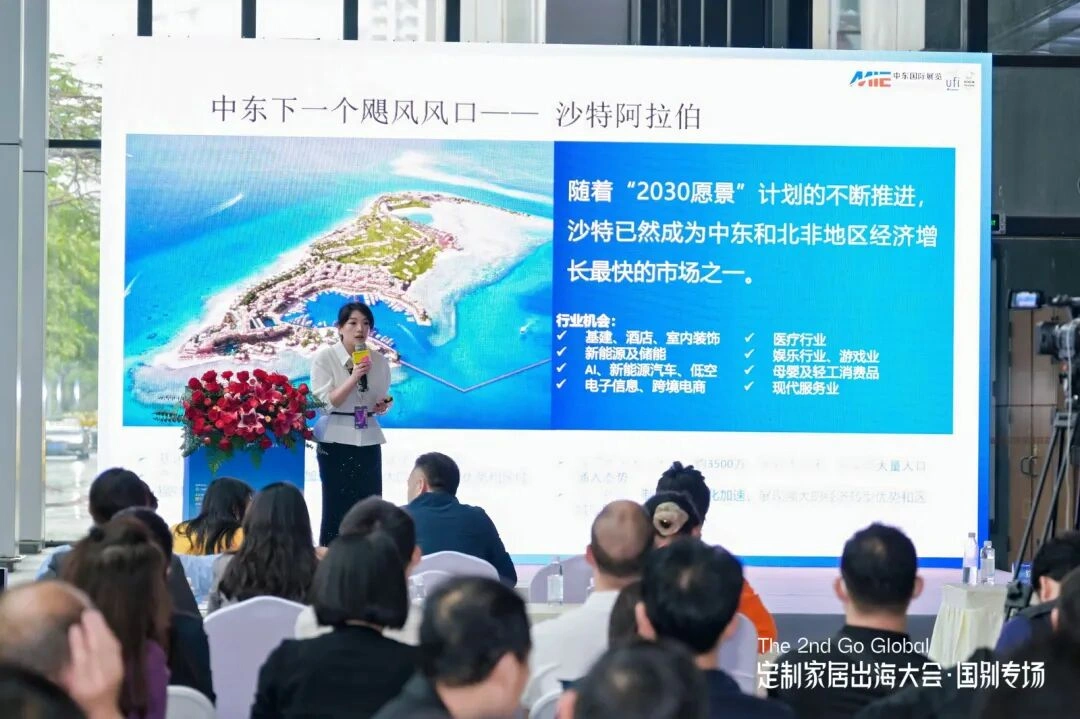
She noted that while short-term challenges exist, the region’s long-term growth potential remains strong. Key indicators include:
· A RMB 13.9 billion solar-storage project in the UAE signed by PowerChina
· Dubai’s role as the world’s third-largest re-export trade hub, serving a market of 1.5 billion people
· Saudi Arabia’s “Vision 2030,” driving over USD 7 trillion in infrastructure investment
In the UAE, the custom home furnishing market is valued at approximately USD 1–1.2 billion, with an annual growth rate of 5–7%. Rising consumption and the influence of social media are driving demand, while Chinese companies hold competitive advantages in metal products, smart hardware, and premium surfacing materials.
A three-step market entry strategy was proposed:
1. Establish market presence through key exhibitions such as Dubai BIG5 and Saudi INDEX
2. Partner with Chinese EPC contractors to mitigate risks
3. Strengthen localized operations
Successful case studies from companies such as RI TONG Group and CARBINE Furniture provide practical references for market entry.
Malaysia: A Strategic Gateway to Southeast Asia
In the Malaysia session, Meng Hui, Deputy Secretary General of the Guangdong Custom Home Association, highlighted Malaysia as a strategic entry point for Chinese companies.
With a population of approximately 34 million and a GDP per capita of USD 14,000 (2024), Malaysia has maintained stable economic growth averaging 4% annually over the past decade. Strong bilateral relations with China and a business-friendly environment further enhance its appeal.

Key market insights include:
· Housing stock: ~6.34 million units (65% landed homes, 35% high-rise)
· Hospitality sector: over 5,200 hotels and 330,000 rooms, growing at 4% annually
· Furniture trade: exports of RMB 20 billion; imports of RMB 8.06 billion, with China accounting for nearly 70% of imports
The local market is largely designer-driven, with high expectations for design, quality, and customization services. Leading Chinese brands such as GoldenHome, OPPEIN, Sophia, ZBOM, and Supina have already entered the market through manufacturing and retail expansion.
Four key takeaways for Malaysia:
1. One of the most mature custom home furnishing markets outside China
2. High market maturity leads to stronger business survival rates
3. Rapid growth expected as Chinese brands enter and local companies upgrade
4. Early-stage opportunities may narrow within 1–2 years, but long-term growth remains strong (5–10 years)
Recommended entry strategies include:
· Project channels (hotels, fully furnished apartments)
· Design-driven project execution (serving design firms and high-end residences)
Local distributor partnerships
Russia: Capturing Market Gaps Amid Industry Restructuring
In the Russia session, He Shan, Project Manager at ITE Group, outlined the evolving landscape of the Russian market.China has remained Russia’s largest trading partner for 15 consecutive years, with bilateral trade reaching USD 245 billion in 2024.

Following the exit of many European brands, the Russian home furnishing market has opened up over 30% in trade opportunities and more than 50% in unmet consumer demand.
Market size and outlook:
· Total home furnishing market: USD 27.3 billion
· Furniture segment: ~USD 7.3 billion
· Projected growth to USD 9.2–10 billion by 2030–2033
· CAGR: 2.7%–6%
Consumer behavior shows a preference for online research followed by offline purchasing, with growing demand for mid-range products.Additionally, Russia’s policies supporting building materials and wood processing industries present opportunities for Chinese companies to extend their value chains.
Thailand: Building a New Strategic Base in Southeast Asia
In the Thailand session, Chen Ran from Detao Holdings highlighted Thailand’s strong import dependence (60–62%) and growing demand for custom home furnishing, with annual growth of 15–20%.
Thailand’s manufacturing sector is dominated by SMEs, many of which face outdated equipment and limited R&D capabilities. As a result, high-end building materials rely heavily on imports—creating a window of opportunity for Chinese companies.

Regional demand highlights:
· Bangkok: strong demand for mid-to-high-end customization and rental housing solutions
· Chiang Mai: growing demand driven by Western retirees
· Phuket & Pattaya: sustained demand from short-term rental renovations, luxury hotels, and villas
The market is shifting from basic demand to quality-driven consumption upgrades. With support from RCEP policies, BOI incentives, rubberwood resources, and the Eastern Economic Corridor (EEC), Thailand offers favorable conditions for investment.
Leading Chinese companies such as GoldenHome and KUKA Home have already established operations, providing replicable models for market entry.
Thailand presents a clear blue ocean market, where Chinese brands can leverage their strengths in cost-performance, manufacturing expertise, and fast delivery to gain a competitive edge.
Dual-Platform Synergy Driving Global Expansion
From the success of the inaugural conference in 2025 to the more focused and in-depth country sessions in 2026, China’s custom home furnishing industry is advancing toward global markets with greater precision, structure, and confidence.
Each session—whether on the Middle East, Malaysia, Russia, or Thailand—offered a clear roadmap for navigating international markets.

During the conference, the “China Custom Home Furnishing Overseas Development Service Platform” continued to play a key role by integrating global resources and connecting industry stakeholders, forming a highly efficient and collaborative international service ecosystem.
Looking ahead, the Guangdong Custom Home Association and CCHF will continue leveraging their dual-platform synergy to support Chinese companies in bringing high-quality products and services to global markets—helping create smarter, better living environments worldwide.
- About the exhibition
- Exhibition Center
- Visitor Services
- Information Center
- Exhibition services
- Contact Us




zhonglianw.com
ARCHIDEX Exhibition
Indonesia International Custom Home Furnishing EXPO
法律声明
GUANGZHOU BOJUNHOME 广州博骏家居科技有限公司©版权所有
Copyright 2022-2029 BOJUN EXPO.All rights reserved 粤ICP备15057367号